
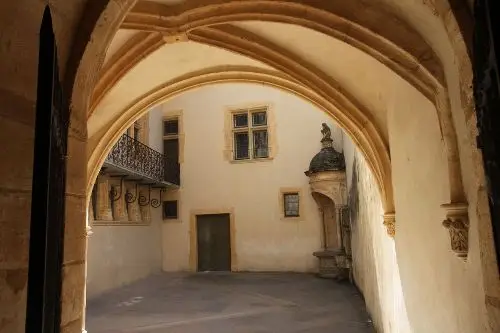
ℹ️ Access is now closed to the public for two main reasons:
- Restoration and renovation projects: Following an initial renovation in the mid-2000s, the building (which had long been unoccupied and dilapidated) underwent a major private rehabilitation and heritage restoration project (facades, structures, frescoes). During these phases of work, the courtyard was closed for obvious safety reasons.
- Privatizing it and protecting the site: The building having been sold and divided into private apartments and commercial premises, the inner courtyard — which houses the famous Gothic stair tower and the well attributed to Philibert Delorme — has once again become a private space reserved for residents.
This is why guides and enthusiasts of Old Lyon regret this closure: previously, one could pass through the porch to observe very closely the well, the Italian-style painted gallery and the stair tower.
The well, attributed to Philibert Delorme, is surmounted by a sculpted lion and coffers decorated with rosettes. The gallery on the first level displays the coat of arms of the d'Estaing family, notably a fleur-de-lis and a laurel wreath. The fresco in the humanist study of the west gallery is an Italianate masterpiece, highlighting the refinement of the decor.
The mullioned windows, sculpted vaults and ornamental details bear witness to the refinement of the period. This courtyard, steeped in history, embodies the harmonious blend of medieval tradition and Renaissance innovations, making the Maison du Chamarier an essential place to discover Lyon's heritage.
Role of the Chamarier
The term "Chamarier" (coming from Latin cameriarius, "intendant of the chamber") historically designated an important function within the clergy, particularly with a bishopric or a cathedral chapter (chapter of Saint-Jean sur Lyon).
His main roles were:
- Finance Intendant: He was responsible for managing the financial resources of the bishop or chapter. This could include managing assets, income, and expenses.
- Keeper of the Keys: He held the keys to the gates of the canonical enclosure (the area surrounding the cathedral where the canons resided). This was a sign of trust and significant responsibility for the security of the place.
- Tax Collector (from the 15th century): In an evolving role, the chamberlain became responsible for collecting taxes at fairs, which closely linked his ecclesiastical function to the economic activity of the city.
The chamarier was therefore a key figure, both ecclesiastical and managerial, playing an essential administrative and financial role, especially in a city like Lyon with a strong religious and commercial presence.


