
 Visite guidée complète en 1 journée
Take the Ficelle – the Lyon funicular

The Lyon funiculars have existed since 1862 and were once part of a larger network, notably towards Croix-Rousse. Today, only two remain in service.
Minimes stop: start of the walking route

This is where the walking tour begins. The station is literally at the foot of the archaeological site.
Upon exiting, you immediately arrive at the stands of the Grand Théâtre and the Odéon, two of Lyon's major ancient monuments. Just a little further down are the ancient baths.
Ideal for starting the visit with Roman history before heading up to the basilica.
Ancient baths of Lyon

Located below the theaters, these remains testify to the importance of hygiene and social life in Roman times. Built in the 1st century AD, these public baths comprised the three traditional rooms: the frigidarium (cold bath), the tepidarium (warm bath) and the caldarium (hot bath).
The underfloor heating system, called hypocaust, where hot air circulated under the slabs supported by small stacks of bricks.
Odeon of Lyon

Near the theatre, the Odeon, the smallest Roman theatre, was used for musical performances and public readings. Don't miss its marble inlays on the floor.
Gallo-Roman Theater

Today, this place steeped in history still hosts cultural events, notably the Nuits de Fourvière festival, which combines art and heritage in an exceptional setting.More information HERE.
Basilic insula

Discover the remains of Roman houses (insulae) located right next to the ancient forum, before heading up towards the Basilica.
Basilica of Our Lady of Fourvière
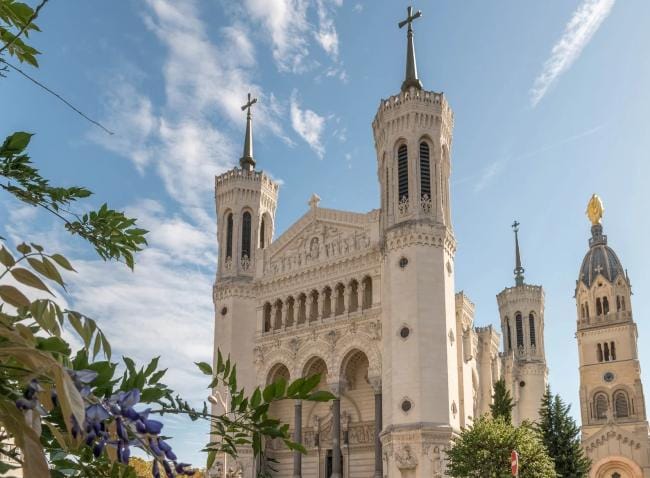
Visit this basilica with its neo-Byzantine architecture. Admire its impressive mosaics and its crypt dedicated to Saint Joseph.
More information HERE.
Four Winds Footbridge

A true aerial link within the Heights Park, This footbridge follows the route of a former railway line that once connected the Loyasse cemetery to the Saint-Paul funicular. Suspended above the valley, it offers one of the most spectacular panoramas of Lyon, without the crowds of the Basilica esplanade. From here, one can admire a breathtaking view of the Saone, the district of Red Cross and the iconic Metal Tower which rises right next to it.
Esplanade of the Notre-Dame de Fourvière Site

Admire the panoramic view of the entire city from the esplanade. It's the most famous viewpoint in Lyon.
Rosary Garden

Begin the descent towards Old Lyon via this path winding through the gardens and orchards of the hill.
Chazeaux Ascent

Finish the descent via this steep stone staircase offering a unique perspective on St. John's Cathedral.
Cathedral and Primatial Church of Saint John the Baptist

Saint-Jean Cathedral, a Gothic and Romanesque jewel of Old Lyon, is an emblematic monument of the city, with its dazzling stained glass windows and marked history. It houses a 14th-century astronomical clock, a mechanical marvel that indicates the time, celestial positions and religious festivals. Every day, figurines come to life at specific times, offering a unique spectacle to visitors. This fascinating clock is a testament to medieval know-how and makes the cathedral an essential part of Lyon's heritage.
The Manécanterie

The Manécanterie (manicanteria means "singing house" in Italian), a historic monument of Lyon, is located in the Saint-Jean district, just southwest of the Saint-Jean Cathedral, of which it was part of the former cloister. Initially used by the canons of Saint-Jean, it later became a real singing school intended for the training of young clergy choristers.
More information HERE.
Archaeological Garden

The Archaeological Garden of Saint-Jean, located in Old Lyon near the cathedral, is a historical site rich in remains that reveal the religious importance of the district over the centuries. It houses the ruins of an ancient ecclesiastical complex, called the cathedral group, which once included several religious and administrative buildings. This episcopal group, led by the chapter of Saint-Jean, included in particular the churches of Saint-Étienne and Sainte-Croix, now disappeared, having been destroyed during the French Revolution, as well as the current Manécanterie, a building that served as a singing school for choirboys.
Cinema Museum (Former lawyers' house)

The courtyard of the Maison des Avocats, in the heart of Old Lyon, is a place steeped in history that evokes the medieval atmosphere of the city. Today, this building houses the Musée Miniature et Cinéma, but its history is much older and more captivating.
La Longue Traboule (54 rue Saint-Jean)

There Long Traboule, located at 54 rue Saint-Jean in Vieux Lyon, is one of the most emblematic and fascinating traboules in the city. It connects rue Saint-Jean to rue du Bœuf, crossing several courtyards and buildings in a series of secret passages typical of Lyonnaise architecture. This passage, approximately 50 meters long, offers an immersion in the history of Lyon, in the heart of Renaissance buildings with elegant interior courtyards, spiral staircases, and stone galleries.
The Pink Tower (Sift House)

Located at 16 rue du Bœuf, this ochre spiral staircase tower is one of the jewels of the Saint-Jean district. The Maison du Crible, also known as the "Pink Tower" because of its ochre spiral staircase, is located at 16 rue du Bœuf, in Vieux Lyon, the 5th arrondissement. This Renaissance building, emblematic of its architecture and distinctive tower, is one of the jewels of the Saint-Jean district. Listed as a historical monument since 1937, the house embodies the rich history and heritage of this part of Lyon.
The Charvet clock

Installed in 1852 (previously located on rue de la Poulaillerie), this monumental clock, 7 meters high, is a masterpiece of automaton clockmaking:
- The mechanism: A 100 kg dial controls five gilded bronze bells and a troupe of famous automata.
- The robots: Every quarter of an hour, the Lyon icons Guignol and Gnafron strike the large bell, while Harlequin and Polichinelle ring the others.
- Private Trumpet: Added after the war of 1870, this character comes out of his niche every hour on the hour to sound the bugle.
Lyon History Museum – Gadagne

The courtyard of the Gadagne Museum, open to visitors, offers two contrasting facades. The north facade (10-12 rue Gadagne), built in the 1520s-1530s by the Pierrevive family, is distinguished by its geometric door frames of Italian inspiration and its oval oculi restored in 1960. It houses the puppet museum, the history museum and a documentation center.
The southern façade (14 rue Gadagne), more sober, dates mainly from the 17th century with windows typical of the period and a floor added in the 19th century, where there is a small theater.
Renaissance turret

Look up at the corners of the buildings to spot these defensive and prestige features typical of the Lyon Renaissance.
Philibert de L'Orme Gallery
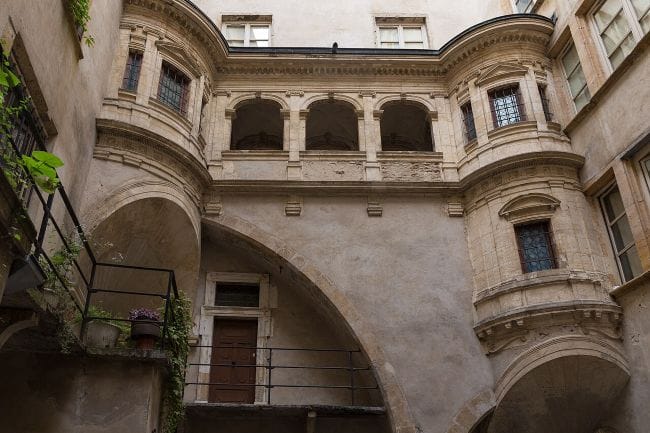
The courtyard of the Hôtel Bullioud is a Renaissance masterpiece in Lyon, designed by the architect Philibert Delorme. It is distinguished by a suspended gallery with elegant arcades and columns, which illustrate the architectural innovation of the time and the Italian influence.
Henri IV House (Hôtel Paterin)

Also called Paterin Hotel, this Renaissance residence from the early 16th centurye century is one of the jewels of the Saint-Paul district.
One can admire there a monumental staircase, an elegant wrought iron well of the 17the century and facades blending late Gothic and Italian influences.
Tradition dictates that’Henry IV he stayed there during his visit to Lyon, a legend which gave the house its name.
Claude de Bourg's House

A magnificent Renaissance residence, famous for its facade and sculpted decor.
Thomassin House

One of the oldest facades in Lyon, blending Gothic and Renaissance styles on Place du Change.
"External" stair tower«

Mentioned as early as the late 15th century, the building underwent extensive renovations in the mid-17th century, giving it its current appearance. It features a unique and innovative façade: the square-plan stairwell marks the axis of symmetry. It extends two stories above the rest of the building, forming a belvedere.
Traboule of the old Government Palace

A monumental passageway linking the Place du Gouvernement to the banks of the Saône.
Lyon Courthouse

The historic monument of the "24 columns", a neoclassical masterpiece facing the Saône.
Footbridge to the Palace of Justice

Cross this red footbridge to leave Old Lyon and enter the Presqu'île.
Templars' Street

Join this street at number 11 Place Antonin Gourju to reach Place des Célestins: a vestige of the passage of medieval orders on the left bank of the Saône.
Place des Célestins

Admire the facade of its theatre. Look for the central periscope to see the award-winning underground parking garage.
📸 UNUSUAL EXPERIENCE: THE ARTWORK "UPSIDE DOWN"«
In the center of Place des Célestins, a periscope offers a view of a giant rotating mirror at the far end of the parking garage. For a truly immersive experience, enter the underground parking garage directly (level -2). There, you'll discover a spectacular view of the circular architecture and Daniel Buren's mirror.
Place des Jacobins

An iconic location on the peninsula.
Admire the magnificent Jacobins Fountain, restored in 2013, which is a 19th century masterpiece.
The Jacobins Fountain
- Origin and Creation : The central fountain of the square is the most emblematic element. Designed by the architect Gaspard Andre and inaugurated in 1885, it represents a masterpiece of neoclassical art.
- The Statues : The fountain features statues of four famous artists who contributed to the artistic influence of Lyon: Philibert Delorme (architect), Germain Pilon (sculptor), Guillaume Coustou (sculptor), and Hippolyte Flandrin (painter).
- Anecdote : The fountain has been restored several times, with the last major restoration taking place in 2013 to restore its original shine and splendor.
More information HERE.
Merciere Street

A historic thoroughfare for printers in the 16th century, now a street of restaurants and traditional Lyonnais bistros.
Printers' Passage

A secret passage reminiscent of the golden age of printing in Lyon in the 16th century.
Remarkable courtyard and passageway

An exceptional ensemble: stroll through its 15th-century walkways adorned with grotesques to discover a Renaissance courtyard, a sculpted well, and two monumental stair towers (round and hexagonal) with impressive spiral staircases. Its exterior façade dates from 1654.
Saint-Nizier Church

Gothic and Renaissance church with two asymmetrical spires, located in the heart of the Presqu'île shopping district.
Traboule of the Printing Museum

Historic passage leading to the former Hôtel de la Couronne, a testament to the prestigious past of Lyon's printing industry.
Old Town Hall

Before moving to Place des Terreaux, this building was the first seat of Lyon's municipal power:
- 1462 : After years of struggle against the power of the Archbishop, the Consulate (ancestor of the town hall) finally settled there.
- Architecture : The current buildings retain the soul of the 15th century, despite a fire in 1513 and major alterations in 1576.
- Evolution : This was the political heart of the city until 1604, when the Consulate moved to build the current City Hall.
Traboule Le Passage

Number 8 rue du Plâtre (which leads to number 11 rue de la Poulaillerie) houses one of the most spectacular and best-hidden courtyards on the Presqu'île. This passageway, often called "Le Passage," is a perfect example of Lyon's urban density magnified by its architecture.
Old Church of Saint Peter

This former church of the Abbey of the Ladies of Saint-Pierre is a hidden gem in the Terreaux district:
- Millennial origins: Founded in the 7th century, it retains a narrow 12th-century facade and a listed Romanesque portal.
- Sacred details: Its 18th-century doors bear the papal coat of arms and the monogram "IHS".
- Metamorphosis: Decommissioned in 1907, it is now part of the Museum of Fine Arts where it serves as a majestic exhibition hall for sculptures.
Place des Terreaux

Centre of Lyon's civil power since the 17th century, redesigned by Daniel Buren with 69 water jets symbolizing the 69 departments of the Rhône.
Bartholdi Fountain

A 21-ton lead masterpiece representing the Garonne River, purchased by Lyon at the origin of the Universal Exhibition.
🔍 Details of the Fountain: Observe the horses of the Bartholdi fountain. Their nostrils project water vapor in winter to simulate the effort of racing. It is one of the few "living" monuments in Lyon.
Lyon City Hall

Admire the imposing façade of the City Hall, considered one of the most beautiful in France. Built in the 17th century, it symbolizes the power of the city of Lyon in the face of royal power.
Cloister and garden of the Museum

This immense building was once a Benedictine abbey in the heart of the city. The museum's cloister is one of the most tranquil and secluded gardens on the Presqu'île. This place is a true haven of peace within the Museum of Fine Arts.
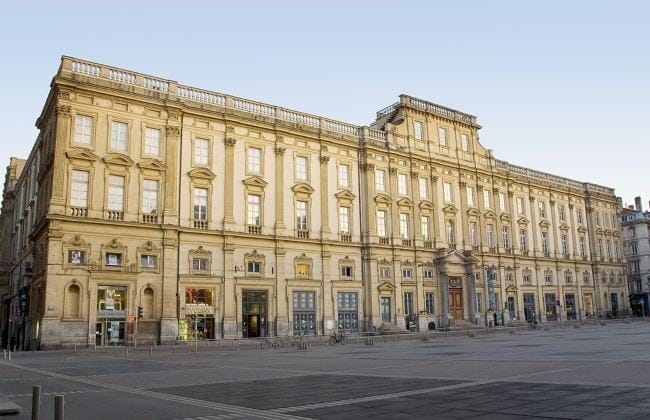
Traboule Place des Capucins

This passage is emblematic of the architecture of the slopes:
- The entrance: A long, dark corridor unexpectedly opens onto a monumental and very bright courtyard.
- The setting: It is surrounded by high-rise buildings, formerly owned by wealthy silk merchants.
- The atmosphere: Completely renovated, it offers a very clean appearance but is sometimes considered less "authentic".
- The exit: A staircase runs through the whole thing to lead directly to Rue des Capucins.
Ascent of the Grande Côte

An old Roman pedestrian road lined with artisan shops, climbing towards the Croix-Rousse plateau.
Ascent to the Amphitheater

A detour to observe the traces of the Amphitheatre of the Three Gauls, a major Roman vestige of Lyon.
Panoramic view of the Grande Côte

The ideal viewpoint to observe the layout of the city before heading back down towards the slopes.
Pouteau Street Staircase

A typical staircase in the Canuts district, often adorned with street art and murals.
Traboule and Courtyard of the Voraces

Famous for its monumental openwork staircase, a symbol of the revolt of the silk workers and the Canuts of Lyon.
Place Chardonnet

An authentic, quiet and tree-lined neighborhood square on the heights of the slopes of Croix-Rousse.
Mermet Staircase

Famous for its colorful steps, a must-see for photographers and street art enthusiasts.
Thiaffait Passage

A former traboule, now rehabilitated, houses the creators' village, with artisan workshops and design boutiques.
Saint-Polycarpe Parish: The scars of history

Beyond its role as the church of the Canuts (silk workers), the façade of Saint-Polycarpe (rue René Leynaud) bears the marks of the battles:
- Shell impacts: By carefully observing the facade, one can see chips and traces of impacts. They date from the Lyon uprisings of 1834 (the second Canut revolt), when the army violently repressed the silk workers who had entrenched themselves in the slopes.
- The symbol: These marks make the church a true witness to the "working hill" and the suffering of the silk weavers.
Place du Forez

A small, peaceful square connecting the slopes of Croix-Rousse to the Opera area and the Presqu'île.
Place Louis Pradel

A modern space linking the slopes to the City Hall, a favorite spot for Lyon skaters.
Lyon National Opera

In contrast to the classic stone, its black glass dome was designed by architect Jean Nouvel.
Lumière Brothers Plaque

A tribute to the inventors of cinema in Lyon, located on Rue de la République.
Rue Pizay – Rue du Garet

A picturesque little street famous for its restaurants and lively nightlife.
Chapel of the Trinity

A 17th-century Baroque masterpiece, renowned for its exceptional acoustics and prestigious concerts.
Menestrier Street
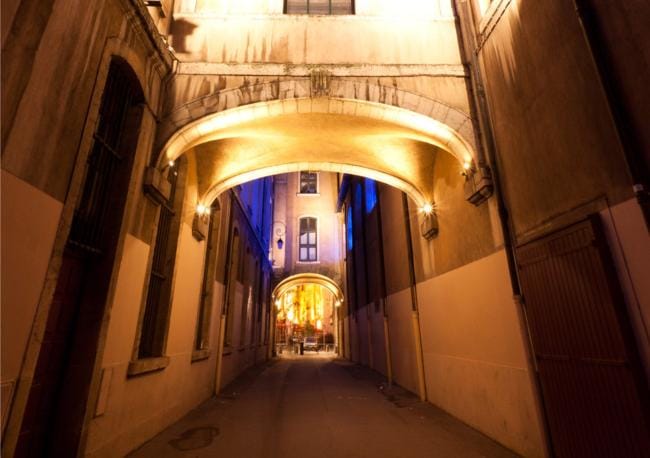
Historic street running alongside the Collège de la Trinité, a witness to Lyon's educational history.
College Gateway

Offers an unobstructed view of the banks of the Rhône and the Hôtel-Dieu. An ideal vantage point for photographers.
Lyon Stock Exchange Palace
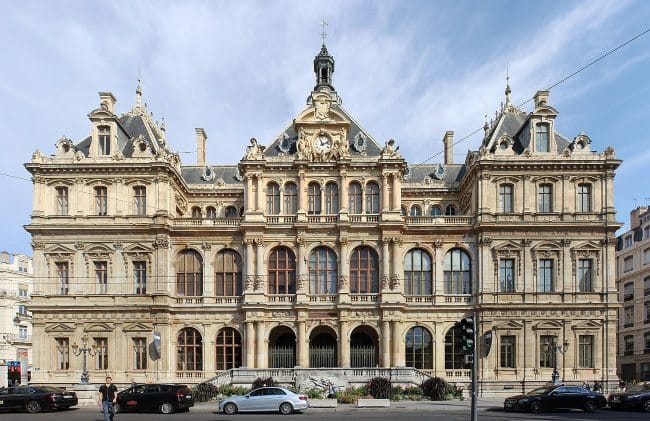
Located at Place des Cordeliers and listed Historic Monument :
- Role : Built between 1855 and 1862, it was the heart of Lyon's economic activity (Chamber of Commerce, Commercial Court, Stock Exchange).
- Architecture : It is an imposing building, representative of the splendor of the Second Empire.
Saint Bonaventure Basilica of Lyon

Although slightly set back, it is located right at the entrance to the street at the Cordeliers level.
- Style : It is a church style Gothic Built in the 14th century and remodeled, it offers an interesting contrast with the surrounding Haussmannian architecture.
Republic Street

The ideal street for a bit of shopping or simply to enjoy the lively atmosphere.
Rue de la République in Lyon, often nicknamed "Rue de la Ré," is a major artery on the Presqu'île, primarily known for its commercial role. However, it is itself an important historical and architectural site, and is lined with major cultural sites.
The street itself is the main historical testimony. It was opened during the Second Empire by Prefect Vaïsse (nicknamed the "Haussmann of Lyon") and was initially called the Imperial Street (opened in 1859).
- Style : Observe thehomogeneous architecture neoclassical and Second Empire style that lines the street, with its aligned facades, Mansard roofs and ornaments. It is a textbook case of mid-19th century urban planning.
Place de la République

Central point of the peninsula with its large basin and elegant Second Empire style buildings.
Argue Passage

A covered passage dating from 1825, housing luxury boutiques and antique hat shops, a veritable historic shopping arcade.
Hospital Square

Place de l'Hôpital, located in the Presqu'île (Lyon 2nd arrondissement), is the historic forecourt of the Grand Hôtel-Dieu. Once the nerve center of Lyon's medical community, it is now an elegant and peaceful space that connects the shopping area of Rue de la République with the banks of the Rhône.
Key points to remember:
- THE Grand Hotel-Dieu The square runs alongside this majestic monument, which was transformed in 2018 into a living space combining luxury boutiques, gastronomy and interior gardens.
- There Baroque Chapel : A 17th-century jewel integrated into the square, it is distinguished by its carved walnut portal and its richly restored interior, adorned with trompe-l'œil paintings.
- Medical legacy: The statue of Marcel Mérieux in the square reminds us that Lyon is a historical capital of biology and health.
- Atmosphere: A site with monumental architecture, ideal for admiring Soufflot's domes or enjoying a quiet terrace away from the crowds.
The Chapel

Welcome to the Chapel, built in the 17th century on the site of the old medieval hospital and integrated into the first Hôtel-Dieu, initiated by the Italian rectors César Laure and Antoine Mey. Inspired by the Church of the Gesù in Rome and in accordance with the principles of the Counter-Reformation, it embodies the power of the Church with its imposing façade, its Latin cross plan, its single nave and its luminous dome.
Work began in 1637 and, despite delays due to the plague, the church was consecrated in 1645, the façade completed in 1646 by Pierre Le Muet. Admire the high reliefs, sculpted clusters and grotesque head motifs, signs of the power of the rectors. A place of prayer for the sisters, the Chapel saw the baptism of more than 30,000 children after the Second World War.
Grand Hotel-Dieu

A recently renovated architectural masterpiece. Explore its magnificent courtyards (Cloister, Saint Louis, Saint Henri, Sainte Elisabeth, Saint Martin, du Midi).
Discover below the areas of the Hôtel-Dieu with historical significance:
The Cloister Courtyard
The Cour du Cloître is the oldest and most authentic part of the Grand Hôtel-Dieu, where you can admire the 17th century hospital, as well as remains from the 15th and 16th centuries. You are on the old cemetery, while the current Chapel replaced the sick room.
In 1637, the rectors of the Hôtel-Dieu built this complex with a cross-shaped plan, inspired by the Ospedale Maggiore in Milan. The central dome, visible when looking up, served as a ventilation chimney and a chapel for the sick to attend mass.
Note the upstairs windows, designed to ventilate without disturbing the patients, and the small dome sculpted by Delamonce at the southwest corner, marking the former main entrance. Under the arcades, the tailors' marks and plaques commemorating donors recall the history of this place.
The Saint Louis Court

This courtyard represents the transition between the 17th and 18th century hospitals. On the left, you can see the eastern and southern arms of the hospital in the form of a cross of the "four rows", and on the right, the back of Soufflot's large façade. Note the difference in level: during the 18th century extension work, the quay and façade were raised to prevent flooding.
Formerly a vegetable garden in the 17th century, this courtyard has always been very green. In 1825, a pendulum fountain was added, similar to another, older one, visible in the Sainte Élisabeth courtyard.
The Saint Henri Court

The Cour Saint Henri, or Cour d'honneur, is the most beautiful imprint left by Soufflot during the 18th century enlargement of the Hôtel-Dieu. Chosen to impress travelers arriving by the Pont de la Guillotière, Soufflot, then aged 27, designed the Grand Dôme and the surrounding wings.
Admire this 250-meter neoclassical façade along the Rhône, with its harmonious proportions of the golden ratio. After the visit, observe it from the Quai Jules Courmont.
The Dome served as a chapel and a ventilation chimney, evacuating stale air from the rooms. The stained glass windows and the former refectory recall the religious life of the hospital sisters, who took their meals in silence. The peristyle, designed by Soufflot, was completed in the 19th century.
The Saint Elizabeth Court
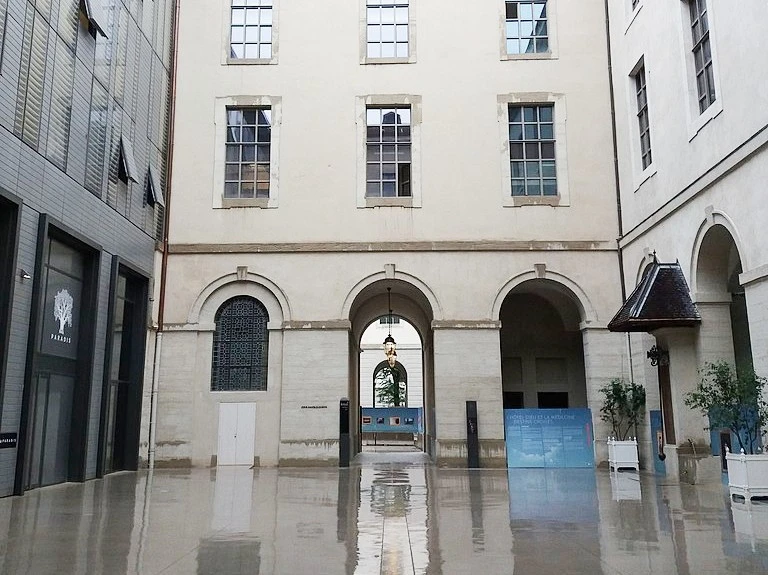
The Cour Sainte Elisabeth, the smallest of the Grand Hôtel-Dieu, dates back to the 18th century. It was initially surrounded by four identical buildings, one of which was replaced by a modern construction. Formerly called Lodge of Fools, it housed the insane on the ground floor, symbolizing the era of “great confinement”.
The asylum, destroyed in 1936, gave way to a boiler room, itself replaced in 1984. Today, the Courtyard has regained its closed appearance. Note the pendulum fountain, with its trough carved from a single block. Each courtyard had its fountain, essential in this "city within the city" where the nuns lived and served the sick.
The Saint Martin Court

The Cour Saint Martin, the last of the 18th century, houses a treasure: the staircase of honor, probably designed by Soufflot. If you come from the Cour Sainte Elisabeth, it is on the left after the passage, and if you arrive from the Cour du Midi, it is right in front of you. Admire the steps and the balustrade, a masterpiece of stone and ironwork, leading to the sick rooms.
Stand to the south of the courtyard to see the alignment of the courtyards, over nearly 250 m, the work of Soufflot. The stone arcades of Villebois allowed the sick to be transported to shelter. The ground floors were used for services, the upper floors for bedrooms, to avoid flooding.
In the 1920s, barracks housed the pediatric ward, causing controversy due to ambulance traffic. The statue of Amédée Bonnet, a pioneer of orthopedic surgery, now stands in the courtyard bearing his name, at the entrance on rue Bellecordière.
The South Court

The Cour du Midi, the most recent of the Grand Hôtel-Dieu, was built at the end of the 19th century by the architect Paul Pascalon, marking the third phase of the hospital's expansion.
This courtyard once housed the morgue, with a burial chamber, a dissection room and a hangar for hearses. Today, the place is lively, with shops and an elegant glass roof. Pascalon added a Dome, but unlike the others, it serves neither as a ventilation shaft nor as a chapel, instead marking his work with a historical stamp.
Before leaving, admire the modern glass roof, reminiscent of the 19th century, and the contemporary entrance on your left, reintegrating the old rue Bellecordière while preserving the original style of the buildings.
Other information HERE.
FNAC Lyon Bellecour
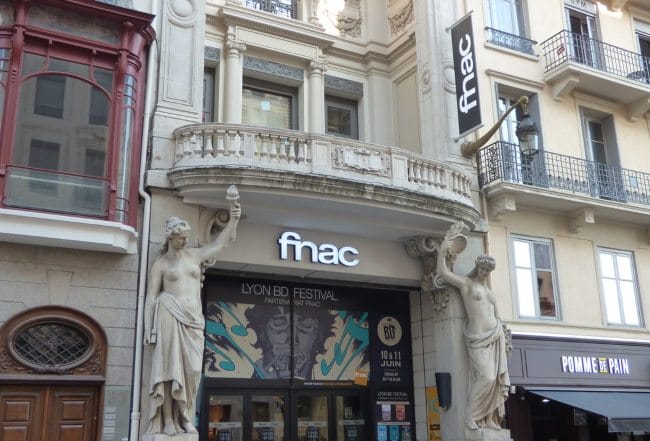
Located in the former headquarters of the newspaper Le Progrès, a building remarkable for its Art Nouveau mosaics.
Equestrian statue Place Bellecour
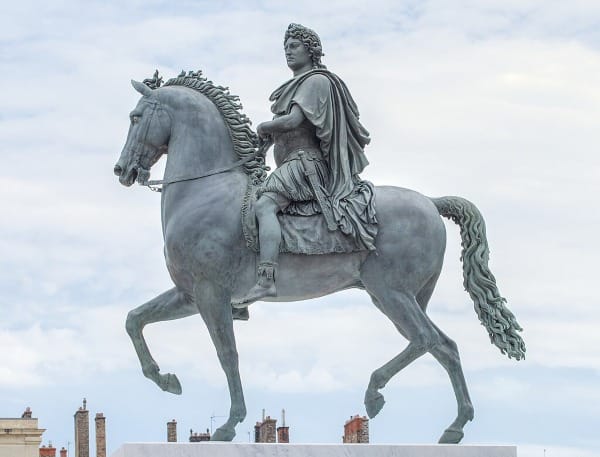
- A Central Point : Standing in the center of the square, the equestrian statue of Louis XIV, made by François-Frédéric Lemot, is a symbol of royal authority. Installed in 1825, it replaced an earlier version destroyed during the Revolution.
- Little Stories : This statue was designed without stirrups, a detail that has intrigued many historians and visitors over the years. Some say it symbolizes the divine power and total mastery of the king.
Place Bellecour in a few figures
- The square measures approximately 312 meters long and 200 meters wide.
- Place Bellecour covers approximately 62,000 m², making it the largest pedestrian square in Europe and the fourth largest square in France.
- Place Bellecour is considered the zero point roads from Lyon. This means that all road distances from Lyon are calculated from this central point.
- Place Bellecour is a major crossroads in Lyon, and six major roads The main points converge there:
- Republic Street : One of Lyon's main commercial arteries, leading towards the Presqu'île and the Place de la Comédie.
- Victor Hugo Street : Pedestrian axis which crosses the 2nd arrondissement and joins Perrache station.
- President Edouard Herriot Street : A shopping street which links Place Bellecour to Terreaux.
- Charity Street Which leads south towards the Ainay district.
- Doctor Gailleton's Quay : Which borders the Saône to the west of the square.
- Guillotière Bridge / Jules Courmont Quay : Connects Place Bellecour to the left bank of the Rhône and the Guillotière district.
Bell tower of the Charity Hospital

- History and Meaning : The bell tower is the only remaining vestige of the Hôpital de la Charité, an establishment founded in the 17th century to accommodate the most destitute. It was largely demolished in the 19th century, but this bell tower was preserved and remains today a discreet witness to the charitable history of Lyon.
- Curious Anecdote Looking at it, few passers-by know that it escaped demolition thanks to the intervention of influential figures who advocated for its preservation.
Banks of the Rhone

Complete your loop with a relaxing stroll along the river. A pedestrian area is ideal for unwinding after your visit.


