
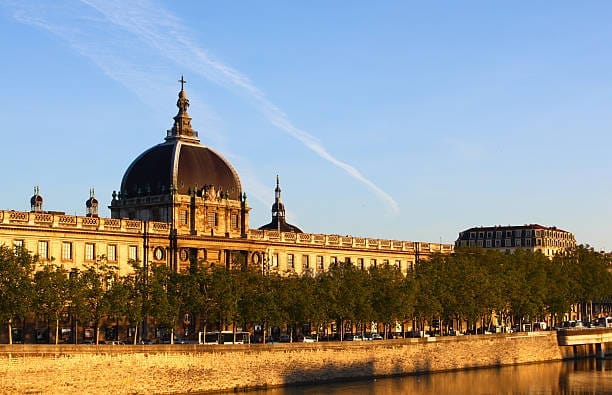
Rehabilitated and reopened to the public, the Grand Hôtel Dieu has become one of Lyon's must-see buildings. This giant bears witness to the city's long medical and architectural heritage, having survived 800 years of Lyon's history and progress.
The most emblematic building in Lyon
Built from the 12th century onwards on the banks of the Rhône, the Hôtel Dieu of Lyon was for centuries one of the most important and famous hospitals in France.
An impressive building with a rich hospital past
This vast 375-metre building ceased its hospital activity in 2010 to become a shopping centre and a luxury hotel. As a figure of Lyon's heritage, it also houses a Cité de la Gastronomie.
Hôtel Dieu: A remarkable hospital past
For 800 years, Hôtel Dieu was the main hospital in Lyon. Renovated many times over the centuries, it is one of the most imposing historical buildings on the peninsula, with its long 375-meter façade along the Rhône, topped by a dome built in 1764.
A notable architectural work
Designed by the architect Jacques Germain Soufflot (18th century), who also designed the Pantheon in Paris, this building aimed to impress visitors arriving in Lyon and to demonstrate the economic power of the city.
A place of birth and medical innovation
Generations of Lyon residents were born in this hospital, which had a maternity ward until its closure in 2010. It was the site of numerous medical advancements, such as the first X-rays, and welcomed many innovative doctors in the 19th and 20th centuries. This hospital made Lyon a bastion of medicine in Europe, where many European monarchs received treatment.
A listed historical site
The Hôtel-Dieu also long housed the museum of the Hospices Civils de Lyon, the building's former owners. It was listed as a historical monument in 1934.
Key dates in the history of the Hôtel-Dieu in Lyon

Originally built on the banks of the Rhône in the 12th century, at the same time as the first bridge crossing the Rhône, the Hôtel Dieu now occupies the right bank of the Rhône on the Presqu'île, between the Guillotière and Wilson bridges.
542 : The first hospital in Lyon was created by King Childebert and Queen Ultrogothe, intended for pilgrims and beggars.
1184 A religious congregation built a settlement on the banks of the Rhône to house these populations. The "Pontif brothers" also built the Rhône bridge linking La Guillotière to the Presqu'île.
1484 The congregation entrusted the hospital to the aldermen of Lyon, the elected officials who managed the city. They expanded the establishment, enabling it to accommodate 200 people.
1532 François Rabelais was appointed physician at the Hôtel Dieu until 1535. It was in Lyon that he wrote his two books Pantagruel and Gargantua, two classics of French literature.
1622 : Considered too small, the premises were demolished and rebuilt with four rooms in the shape of a cross, surrounding a chapel. The cloister and the chapel are still standing and date from this period.
1741 : The municipality planned to build a new quay from Saint-Clair to Bellecour and asked Soufflot to design a large building along the Rhône. Work began in 1741 and the first phase was completed in 1761. The Grand Dôme was completed in 1764. It was damaged during the French Revolution and rebuilt several times. The current façade along the river was completed in the 19th century.
1896 : Étienne Destot creates the first radiography service in France at the Hôtel Dieu.
1923 : Léon Bérard creates the second cancer center in France in the Grand Dome of the Hôtel Dieu.
1944 : The dome was destroyed by fire during the fighting during the Liberation of Lyon. It was rebuilt in the 1960s.
2007-2010 : The hospital services of the Hôtel Dieu are gradually transferred to other hospitals and the building is closed in 2010. The Hospices Civils cede the building to Crédit Agricole Sud-Est.
2018 : The renovated Hôtel Dieu reopens its doors, now called the Grand Hôtel Dieu.
Once largely inaccessible to the public, the Hôtel-Dieu primarily served as a barrier between the Rue de la République and the Rhône River. The two hectares of the Hôtel-Dieu are now open to the public through seven entrances, successfully connecting the riverbanks to the heart of the city.
The southern section of the Hôtel-Dieu, at the corner of Rue Bellecordière and Rue de la Barre, has been transformed into a shopping center with approximately 40 food, clothing, and home goods stores. This is the most recent part of the Hôtel-Dieu, which dates back to the 19th century. Throughout its history, the Hôtel-Dieu has housed shops to help fund the hospital.
Meanwhile, the south cloister has been topped with a large glass roof. This section houses offices as well as restaurants with terraces (Beef House, Wagamama, Buddha Bar…).

The former cloister of the Hôtel-Dieu, accessible from the Place de l'Hôpital, was a parking lot not so long ago. Today, it houses a medicinal herb garden where visitors can stroll or have lunch on the terrace. The garden is a nod to the 16th century, when doctors were primarily botanists and cultivated their plants in the hospital gardens. It is one of the oldest parts of the Hôtel-Dieu (early 17th century).
The Grand Dome, designed by Soufflot to ventilate the hospital and expel germs, rises to a height of 32 meters. It will serve as the lobby of the Intercontinental Hotel, and guests will even be able to access its balcony. The 5-star hotel, with its 143 rooms, will occupy the building's large eastern facade, offering magnificent views of the Rhône River.
The City of Gastronomy will be housed in the cross-shaped building around the small dome, located at the north end of the building. Parts of this section date back to the 16th and 17th centuries.


