
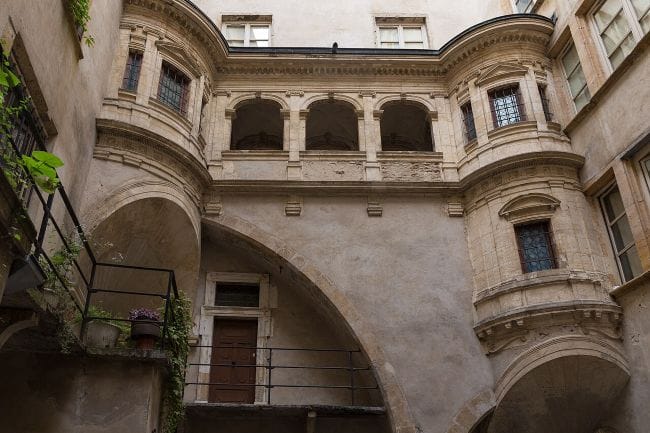
L'Bullioud Hotel It is a Renaissance townhouse located at 5 rue Juiverie in Vieux-Lyon (5th arrondissement). Built in the 16th century for the notable Antoine Bullioud, it illustrates the transition between Flamboyant Gothic and the first models of Renaissance architecture in France.
History and design
Built in 1536, the complex comprises several buildings arranged around two courtyards. The architect Philibert Delorme, Having just returned from Italy, he erected the famous Philibert Delorme gallery connecting two wings. This gallery, superimposing the Doric and Ionic orders inspired by the Colosseum, marks a major step in the introduction of classical vocabulary in France.
Architecture and characteristics
The inner courtyard reveals an innovative decor: Ionic pilasters, cornices, pediments, and friezes with floral or bucrania motifs. The structure rests on squinches, a technical device that avoids encroaching on the courtyard. Sober on the street side and ornate on the courtyard side, the hôtel particulier expresses the pursuit of harmony and symmetry characteristic of the High Renaissance.
Classification and restoration
Class historical monument By decree of October 5, 1920, the Hôtel Bullioud underwent significant restoration in 1985. It can be visited freely from the traboule which leads there and remains an essential testimony of Lyon's patronage in the 16th century.
Heritage importance
A key landmark of Old Lyon's heritage, the Hôtel Bullioud symbolizes the city's openness to Italian influences and Renaissance humanism. Its gallery inspired other Lyon buildings such as the Loge du Change and contributed to the district's recognition as a UNESCO World Heritage Site.


