
14 Beef Street
The house at 14 rue du Bœuf once belonged to the Croppet de Varissan family, an influential lineage in Lyon. In a corner of the courtyard is a well topped with a stone pyramid, erected by the Canons-Counts of Lyon to commemorate the services rendered by the Croppets. During the siege of Lyon by the Baron des Adrets in 1562, one of the family members hid valuable Church documents and relics there.
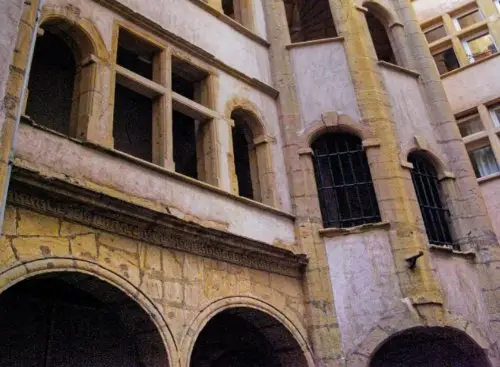
The Croppets, originally from Cologne, settled in Lyon in 1480. Their house, built in the 16th century, has undergone few modifications since then. The architectural ensemble consists of two buildings connected by a gallery on each floor. This gallery, at the end of which is a staircase, allows communication between the buildings. It shows a perspective drawing of the pyramidal monument mentioned above.
The courtyard at 14 rue du Bœuf is a remarkable example of Lyonnaise architecture. Upon entering, one is struck by an elegant access vault consisting of two semicircular arches, separated by a central emblazoned pendant. This element, which appears light, seems to defy the laws of balance, adding an almost magical touch to the whole.
In the centre of the courtyard stands a semi-octagonal tower, resting both on the rear wall and on three pillars supporting two rampant arches. The latter, in the form of squinches, give the whole an architectural stability while preserving an airy character. The spiral staircase that climbs the tower is punctuated by small bays, which subtly shift as one climbs, bringing light and dynamism to the structure.
This courtyard, with its harmonious and complex elements, bears witness to the know-how of the architects and craftsmen of the Lyon Renaissance, creating a space that is both functional and visually impressive.
Each floor has three openings: two small semicircular bays and a rectangular bay divided into four sections by prismatic mullions. The transverse mullion has disappeared, but its trace is still visible. The gallery has lower arches characteristic of certain old houses, notably in rue Treize-Cantons and on montée Saint-Barthélemy. This architecture seems to have been designed to optimize the space between the jambs and create a large communicating bay.


