La Grenette: The beating heart of grain and Lyon's revolts
If you stroll today to the corner of Rue Grenette, Rue de Brest, and Rue Tupin, you will pass by a building that was, for centuries, the true heart of Lyon. Long before it housed fashion or decoration boutiques, the Grenette (or Halle aux Grains) was the place where, each week, it was decided whether the people of Lyon would have enough to eat.
A strategic warehouse on the verge of a riot
From the 15th century onwards, this building served as a warehouse for wheat. On Thursdays and Saturdays, market days, the small rue des Halles (the current rue de Brest) came alive with a dense crowd: peasants coming to sell a few sacks, merchants delivering large quantities, bakers and ordinary citizens.
The price of wheat was then the indicator of the city's economic tension. Every week, the lord of the Grenette The price of grain was recorded in a notebook called a carcabeau. This note was sent urgently to the governor and the provost of the merchants because the slightest price increase could trigger riots. The people, often starving, regularly revolted against the aldermen in charge of policing the market.History and Names
Located at numbers 8 rue Grenette, 21 rue de Brest and 9 rue Tupin, the Grenette (Or Granateria Lugduni (in 1353) is a major monographed work of Lyon's heritage.
- 12th century: Grenette Street is documented as early as 1193.
- 1470 : Archbishop Charles de Bourbon had a new building erected in the form of market halls.
- 1615 : Reconstruction under Archbishop Denis de Marquemont.
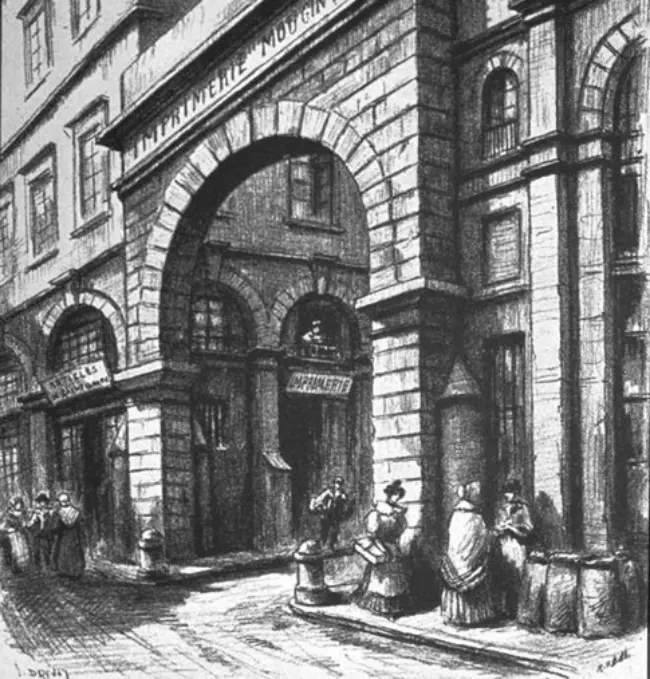
- 18th century: Conversion of part of the ground floor into a printing works (Delaroche, Ballanche, Rusand workshops).
The trauma of 1848: The Breakthrough
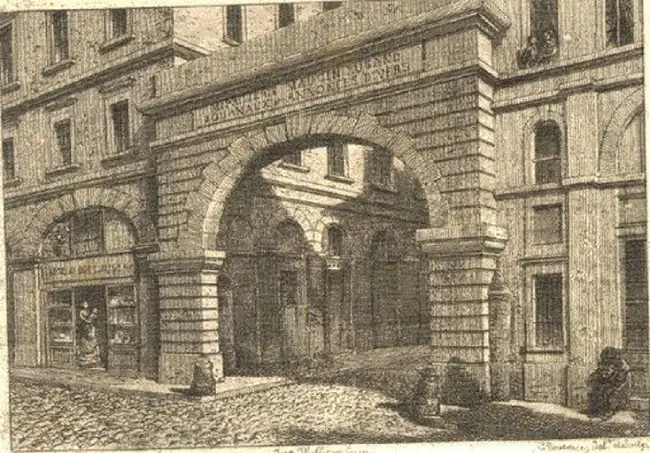
The opening of the Central Street (present-day rue de Brest) in 1848 marked a sudden turning point. It led to the demolition of the western building and the disappearance of the large stone archways which closed off the ends of the alley. Today, only the beginning of an arch on the north facade bears witness to these vanished gateways.
Technical Specifications Architecture
Notable features: Openwork stone railing with rosettes, attributed to the architect René Dardel.
Pillars: The 17th-century pillars are still anchored inside the current shops.