
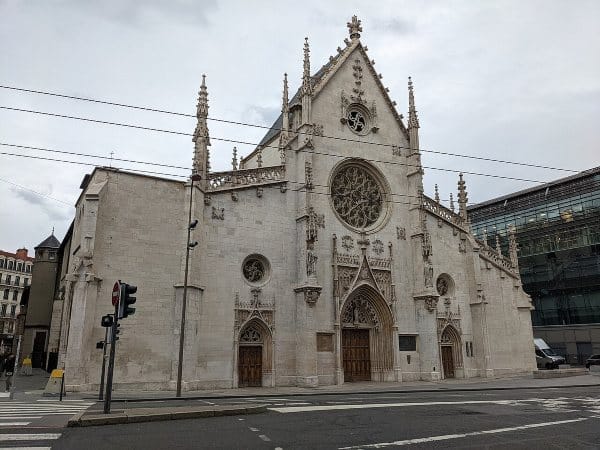
The foundations
Franciscan monks arrived in Lyon at the beginning of the 13th century. Humbert de Grolée gave them one of his properties on the left bank of the Rhône River so they could establish their monastery there. Humbert's grandson, Jacques de Grolée, erected a small church in 1325. Four years later, their church was completed. The entire monastery complex was then finished at the end of the 15th century by Simon de Pavie, physician to King Louis XI.
Immediately, confraternities began to frequent the church: they erected about 20 side chapels! Merchants from the city of Troyes dedicated a chapel to Saint Fortunatus; stonemasons to Saint James and Saint Philip; glaziers to Saint Clair and Saint Luke; cloth merchants to Saint Matthew…
A pilgrimage and riots
And Bonaventure in all this? He was Cardinal Giovanni da Fidenza, nicknamed Brother Bonaventure ("Fortune"), and he died here in 1274.

People from Lyon began making pilgrimages to his tomb, as did kings and queens. Anne de Beaujeu, the daughter of King Louis XI, even offered a magnificent reliquary casket adorned with precious stones.
What else happened here? Well, there was the Rebeyne (a riot in the Lyon dialect), in April 1529. The people of Lyon were unhappy because of yet another increase in the price of wheat. Enough! They were already poor… so they took up arms and gathered in the church. Their goal? To seize the wheat stores intended for the rich! This riot ended in a bloodbath a week later; all the agitators were hanged in the square in front of the church…
A revolution!
The year is 1562: the convent has been damaged by Protestant troops, led by the formidable Baron des Adrets. They occupied the church (converting it into a temple) for several years! King Henry IV of France has pardoned his friend Biron for his first act of treason… the first, but not the last!
In March 1789, a meeting of deputies for the Estates-General was held in the church. Afterwards, it was converted into a barn and riding school. All the works of art were stolen, the side chapels were walled up, the stained-glass windows destroyed… Even Bonaventure's relics ended up in the Saône!

In 1807, they made a new reliquary, an exact replica of the one offered by Anne de Beaujeu (who had disappeared during the Revolution). They placed in it the last remains of Bonaventure found on the banks of the river: a bone and a tooth.


