
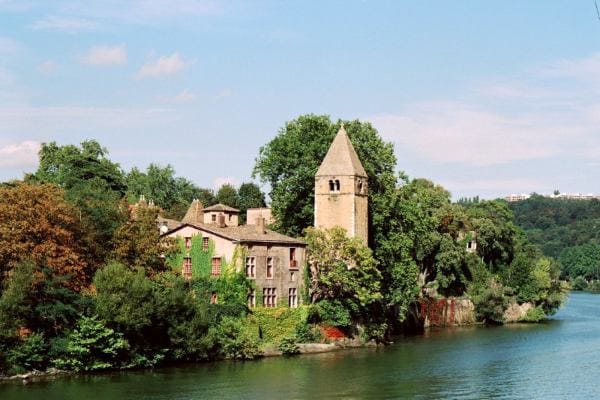
L’Île Barbe, is a historic oasis nestled in the heart of Lyon, on the serene waters of the Saône. Prepare to delve into a past rich in discoveries and soak up the tranquility of this island gem.
History and Heritage
Barbe Island takes its name from the Latin "barbara", meaning "wild". It houses the remains of an abbey dating back to at least the 5th century. Plundered several times, particularly during the Wars of Religion, it experienced periods of prosperity, notably under Carolingian rule. Protected by an enclosure with two gates, it was once dominated by the Châtelard, a fortified building partially rebuilt in the 16th and 17th centuries. The Notre-Dame church retains its bell tower and remains of wall paintings, while the main church, Saint-Martin-et-Saint-Loup, lost its nave in the 19th century. The island also houses other historic buildings, such as the remains of the Saint-Anne priory and the 17th century Provost's Palace.
This historic part is unfortunately inaccessible to the public. Two buildings are classified as historical :
- The Notre-Dame church, which retains its bell tower and remains of wall paintings (see reference).
- Le Châtelard, a fortified building partially rebuilt in the 16th and 17th centuries (see reference).
On the references of the listed sites, you will be able to discover a gallery of captivating images that will immerse you in the heart of their history and architecture. Carefully selected photographs will allow you to admire the fascinating details of these historic sites.
Natural setting

The part just under the bridge is public. Let yourself be enveloped by the serenity of the green banks of the Saône that surround Île Barbe. Enjoy a peaceful getaway far from the hustle and bustle of the city, where the song of birds and the murmur of water soothe you. A walk along the quiet paths of the island will offer you a breathtaking view of the river and its surroundings.

Our self-guided tours of Brotteaux

The bust of Claude-Marius Vaïsse, described as the Haussmann of Lyon
•
March 4, 2024
The Palais de Flore, built by the architect Clément Laval in 1930, stands out for its imposing stature, reaching a height of 40 metres.

The Palais de Flore, the tallest building in France at the time
•
March 4, 2024
The Palais de Flore, built by the architect Clément Laval in 1930, stands out for its imposing stature, reaching a height of 40 metres.

Brotteaux Station, a place full of history and transformations
•
March 3, 2024
Welcome to the Gare des Brotteaux.
Please note that there was once a small wooden and plaster station, built in 1858 to accommodate the Lyon-Geneva line.

Guimet Museum: abandonment or rebirth?
•
February 19, 2024
Welcome to the former Guimet Museum, a place rich in history and artistic diversity.

The little Valla house in the middle of a building
•
February 18, 2024
You are in front of an astonishing scene where past and present meet. Observe the 19th century villa enclosed in an office building.

Brotteaux Crypt – Victims of the Revolution
•
February 17, 2024
Welcome to the Sainte-Croix Chapel, also known as the Missionaries of Our Lady Chapel.

The smallest house at 28 avenue Maréchal Foch
•
February 16, 2024
Stop in front of number 28 avenue maréchal Foch, where you will find a real curiosity: the smallest house in the city.


