Pause for a moment in this small, discreet square, wedged between the bustle of Bellecour and the hustle and bustle of Rue de la République. Beneath your feet lie the foundations of a former hospital where prayers for the sick once echoed. Above, the name engraved on the plaque pays tribute to one of Lyon's greatest surgeons. This tiny square encapsulates four centuries of Lyon's medical and hospital history.
16th-19th centuries: Place de la Charité
The hospital that gave its name to the square
Before bearing the name of the famous surgeon, the square was called Place de la Charité. This name was not chosen at random: it referred to the Charité Hospital that stood here from the 16th century until 1934.

The Charité Hospital was much more than just a healthcare facility. Lyon had been given the title of "City of Alms" and "City of Charity," a title it never denied. This hospital perfectly embodied the city's charitable vocation.
1626: A chapel in the heart of the hospital
At the heart of the hospital stood a remarkable chapel. Completed in 1626, it contained sculptures by Perrache and superb stained-glass windows created in 1890 by Lucien Bégule.

These stained-glass windows were particularly moving because the scenes they depicted retraced the history of the Hospice de la Charité, for which the church served as a chapel.
An illustrious tomb
This chapel housed a prestigious tomb: that of Cardinal Alphonse de Richelieu, Archbishop of Lyon, brother of the minister of Louis XIII.

The cardinal himself composed his epitaph in Latin, a touching testimony to his humility: "Pauper natus sum, paupertatem vovi, pauper vixi, pauper morior, inter pauperes sepeliri volo" ("I was born poor, I took a vow of poverty, I lived poor, I die poor, I want to be buried among the poor").
An astonishing journalistic anecdote
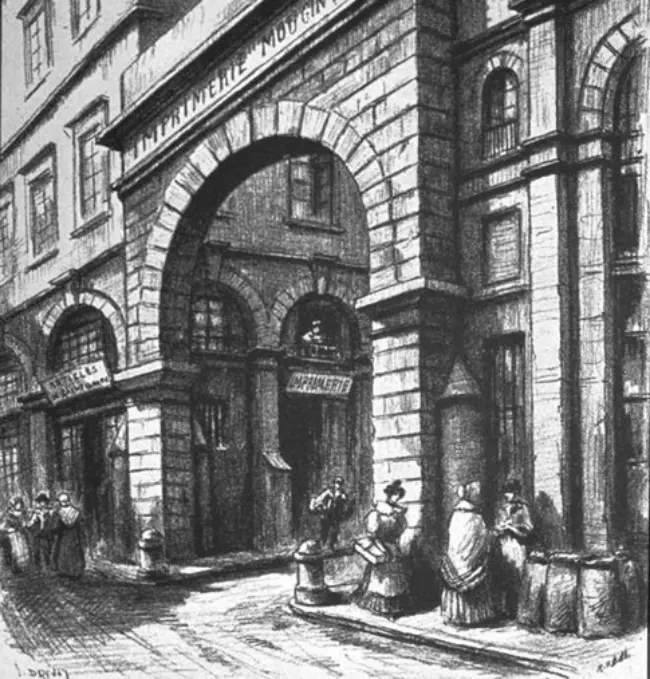
Did you know that this square is linked to the birth of the Lyon press? The daily newspaper Le Progrès was founded in 1859. The first issue, entitled "Le Progrès, Lyon newspaper, daily political newspaper," appeared on December 12, 1859, in the workshops of the Chanoine printing house located in the basement of the maternity ward of the Charité hospital.

Creator of the newspaper “Le Progrès” in 1859.
Who would have imagined that a newspaper would be born in the basement of a maternity ward!
March 28, 1849: Birth of a medical genius
Antonin Poncet: a career of excellence

The man who gave his name to the square was born on March 28, 1849, in Saint-Trivier-sur-Moignans (Ain). He became a Doctor of Medicine in November 1876, but his career was not a long, quiet river.
1876-1879: The Years of Determination
The young Poncet initially experienced failure. In 1876, he applied for the competitive examination for major surgeon at the Charité, but was not accepted. But his perseverance paid off: on June 30, 1879, he was accepted into the competitive examination for major surgeon at the Hôtel-Dieu, at the age of 30.
Ironically, Antonin Poncet did not work at the Charité Hospital, but at the Hôtel-Dieu! The square therefore bears the name of a doctor who worked in a hospital other than the one that gave it its original name.
A pioneer of modern surgery
Antonin Poncet was a surgeon and pathophysiologist at the Lyon Hospitals, who held the prestigious position of chief surgeon at the Hôtel-Dieu de Lyon. His specialty? He was the greatest physician at the Hôtel-Dieu of his time, improving urinary and thyroid surgery. Having become a professor and researcher, he particularly studied rheumatism.
His surgical results were largely influenced by his technical innovation and his concern for asepsis, making him a precursor of modern surgery.
December 29, 1913: A deserved tribute
The Death of the Great Surgeon
Antonin Poncet died on September 16, 1913, at 8 p.m. in Culoz (Ain). His death shocked all of Lyon, which lost one of its most respected medical figures.
The name change
The square officially changed its name by a municipal council resolution on December 29, 1913. Out went the "Place de la Charité," in came the "Place Antonin Poncet." This tribute came just three months after the surgeon's death, a testament to the city's immense gratitude.
1934: The end of a hospital era
In 1934, the Charité Hospital closed its doors for good, marking the end of four centuries of hospital presence on this site.

The square will then experience a new urban configuration, becoming this small breathing space between the major traffic axes that we know today.
A family tribute
Moving anecdote: Pierre Poncet was arrested on July 9, 1944, at 9 Cours Gambetta, along with five companions responsible for the youth of the United Resistance Movements. They were shot on the 12th in Genas. A member of the Poncet family also made his mark on Lyon's history through his involvement in the Resistance.
The legacy of Antonin Poncet
The name of this square serves as a daily reminder of Lyon's medical excellence. This specialist in urinary and thyroid surgery represents the tradition of medical innovation that still makes Lyon's hospitals renowned today.

Next to the old bell tower of the Charity Hospital stands the Lyon Armenian Genocide Memorial, a set of 36 white stelesAt first glance, this monument seduces with its sobriety and verticality, but every detail is meaningful.
These columns are not arranged randomly: they follow the structure of a musical score inspired by an Armenian liturgical chant of Komitas, a major figure in Armenian music. The three rows of steles can be read as three staves, the height and spacing of each column evoking notes and rests, while the poems and texts engraved on some of the steles add rhythm and emphasis.
The visitor who crosses the memorial becomes an interpreter of this symbolic score, visually and poetically feeling the memory of the 1.5 million victims of the Armenian genocideThe empty and engraved steles alternate like notes and silences in a silent melody, creating an immersive experience where art, memory and music meet.
So the memorial is not just a tribute: it is a partition of stone and memory, a space where the memory of the deceased can be read, crossed and felt, inviting each passer-by to become an actor in this universal memory.