Before 1307: The mysterious Templars
Before the theater walls rose, the site was the scene of a little-known story. Originally, this location hosted a Knights Templar Commandery, these soldier-monks with a doubly crucial role in the Middle Ages.Their mission
 They were both protectors of pilgrims in the Holy Land and formidable fighters during the Crusades. But their role did not end there: thanks to massive donations, they became a financial powerhouse capable of managing the fortunes of kings and nobility, turning their commanderies into veritable banks.
Their fall

February 25, 1407: The arrival of the Celestines

The Celestine Convent: Four Centuries of Monastic Life
The Celestine Monastery quickly established itself as an important religious and architectural center. The monks built a church, cloisters, a refectory, and a vast library.
The End of an Era: From Suppression to Demolition
The presence of the Celestines in Lyon ended well before the Revolution. Indeed, the order was officially abolished in 1778 speak Pope Pius VI, This brought an end to its presence across Europe. The fate of the Lyon convent was sealed by history. After the suppression of the order, its assets were initially transferred to the diocesan clergy, then acquired by the Duke of Savoy, who sold them to developers. It was on this newly available land that the first theater, the "Théâtre des Variétés," was built in 1792, foreshadowing the artistic and cultural vocation of the present-day square. The demolition of the convent thus marks the end of one chapter and the beginning of another for this iconic site.1792: Birth of a temple of dramatic art
The history of the Théâtre des Célestins is a saga of destruction and rebirth, earning it the reputation of a "cursed theater." Its story is intimately linked to the location of the square, whose identity it has forever left its mark.The First Theatre: A Stage for the Revolution

A series of fires: the cursed theater
The theatre's fate was disrupted by a succession of disasters. It was completely destroyed by a first devastating fire in 1871.

The Renaissance: the theatre we know today
Determined, Gaspard André set about reconstruction. 1881, he delivered to the city of Lyon a building identical to the previous version. This is the theater that we still admire today. The Théâtre des Célestins is one of the few theaters in France to have preserved its entire decor, a testament to the 19th-century taste for ornamentation and gilding. Recent renovations have modernized it while preserving its historic soul, ensuring its place among the finest stages in France.
The square takes shape: 19th century
An architectural setting for the theater
This square is one of the most pleasant on the peninsula, with its square shape, harmonious and elegant proportions, surrounded by magnolias. This harmony is not the result of chance: it has existed in its current form since the beginning of the 19th century.
1858: The fountain by Michel Liénard

In the center of the square stands a fountain designed by Michel Liénard, sculpted by Moreau and cast by Barbezat, then installed in 1858 by the Compagnie des Eaux (in 1957, the square was redeveloped for the needs of the city: the fountain is destroyed to make way for parking).
20th-21st centuries: Renaissance and innovation
2002-2005: The great renovation
A major renovation was carried out between 2002 and 2005. The theatre regained its former glory while adapting to contemporary requirements.
1994: The underground periscope, a unique curiosity
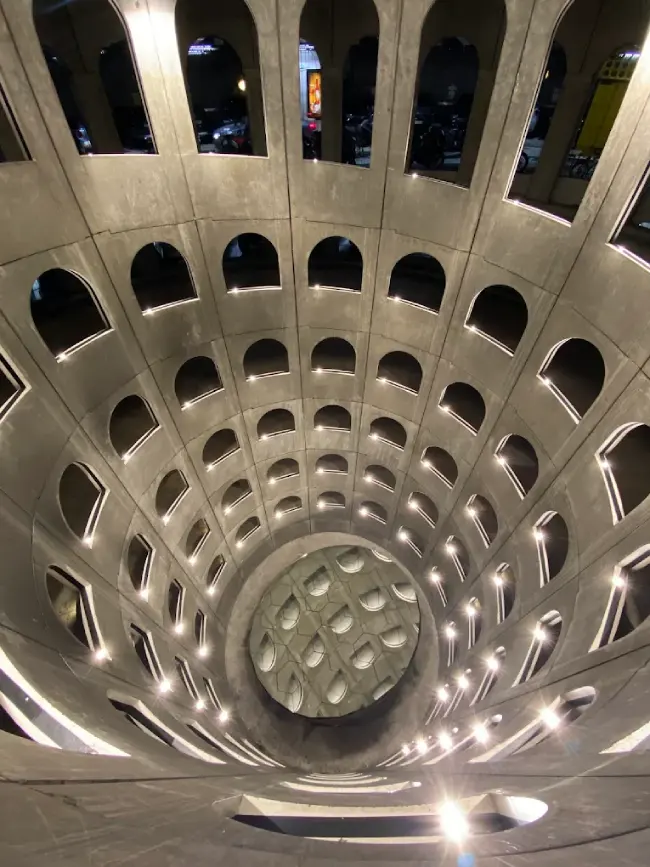
The square hides a surprising modern surprise! The square is a floor pierced with a periscope to admire the rotation of the parking lot. You can go down directly upon entering to admire the viewpoint, it is a cylinder pierced with numerous windows at the bottom of which a mirror rotates and reflects the whole, it dates from 1994.
This art installation even transforms the underground parking lot into a spectacle!
What to see today in Place des Célestins?
The theater: an architectural jewel
To be observed absolutely:
- The neoclassical facade of Gaspard André
- The columns that mark the main entrance
- The stage is located exactly on the site of the former church choir.
- The theater, unique in France, has one of the most beautiful Italian-style halls
Urban planning
Take a walk and observe:
- The perfect square shape of the square
- The magnolias that surround it, creating an elegant natural setting
- The harmonious proportions between the buildings and the central space
- The entrance to the underground periscope (if you're curious!)
The adjacent streets
The square opens onto rue Charles-Dullin and rue Gaspard-André – the latter paying homage to the architect of the place!
Living Legacy
Today, Les Célestins, Théâtre de Lyon hosts and produces great classical works and contemporary creations. The theatrical tradition born in 1792 continues with more than two centuries of dramatic art under its belt.
Did you know? The continuity is striking: from the prayers of the Celestine monks to the applause of the contemporary public, this place has never ceased to be a space of collective communion, only the nature of the shared emotion has evolved.
Thus, crossing the Place des Célestins, you walk through six centuries of history: from the Templar mysteries to today's theatrical creations, by way of monastic spirituality and architectural innovations. Each stone tells a chapter of this fascinating Lyonnais epic where faith, art and architecture blend together.