A religious and urban history
The Dominican monks arrived in Lyon in 1218, and they quickly founded their convent at the current location of the square. This choice was not by chance: large commercial cities like Lyon were ideal places for monks to preach.

The convent became a major religious and intellectual center, not only for the monks but also for the townspeople. It was here that there was a three-nave church and a small chapel, Our Lady of Comfort, which gave its first name to the place: the Comfort Square.

Florentine merchant families even financed expansion work on the church, transforming it into a sanctuary of great devotion.
The square has also been, for centuries, a large graveyard, which was a source of income for the monks.

Over time, families and brotherhoods purchased burials in the church itself.
A place of power and knowledge

Beyond its spiritual role, the Jacobin convent was the scene of major political and intellectual events for France:
The election of a pope : In 1316, the convent hosted a conclave that led to the election of Jacques Duèze, who became the Pope John XXIIThe cardinals, imprisoned by the brother of the King of France, took forty days to decide!
The annexation of Dauphiné : In 1349, the convent was the solemn place where the Dauphin Humbert II ceded his province, Dauphiné, to the kingdom of France.
A study center : For centuries, the convent housed a library and a renowned theological school. It was here that the canons of St. John's Cathedral came to receive their instruction.
The Revolution and the Urban Renaissance
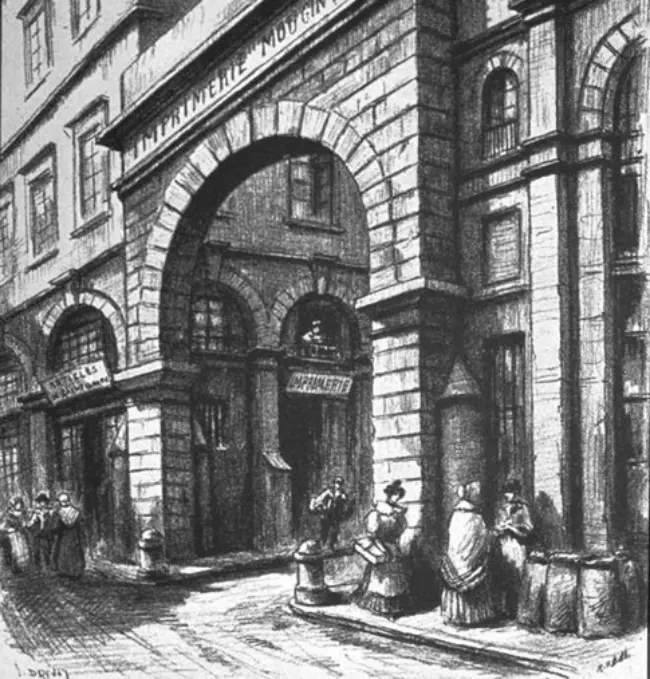
During the French Revolution, the Jacobin order was dissolved. Their buildings, including the convent and church, were demolished in the early 19th century. The first prefecture of the Rhone.

Finally, as part of the major urban planning projects of the Second Empire, the square was completely redesigned. It was during this period that the buildings you see today were constructed and the square took on its current semicircular shape.
Over the centuries, the square has seen its name change in line with France's tumultuous history: it was in turn the "Place de la Fraternité" during the Revolution, then the "Place de la Préfecture" and even the "Place de l'Impératrice" under the Second Empire. It was in 1871 that it definitively regained its original name, in memory of its monastic past.
The Artists' Fountain: a tribute to Lyon's heritage
In the center of the square stands a major work from the end of the 19th century: the Jacobins Fountain. Inaugurated in 1885, it is the work of the architect Gaspard Andre, who also designed the Théâtre des Célestins, and the sculptor Étienne-François-Jacques-Antoine Perret.
This white marble fountain is a vibrant tribute to the artists who have marked the history of Lyon. Its statues represent four major figures of creation:
Philibert de l'Orme (16th century architect)
Guillaume Coustou (17th century sculptor)
Gérard Audran (17th century engraver)
Hippolyte Flandrin (19th century painter)

Completely renovated, Place des Jacobins is now an elegant, pedestrianized space that showcases its heritage. It is a place where history, art, and urban life harmoniously blend together.
The architectural gems of the square
Around the fountain, numerous 19th-century buildings shape the visual identity of the square. They are perfect examples of the style Haussmannian and of eclecticism architectural style of the time.
The rotunda building by Jules Chatron
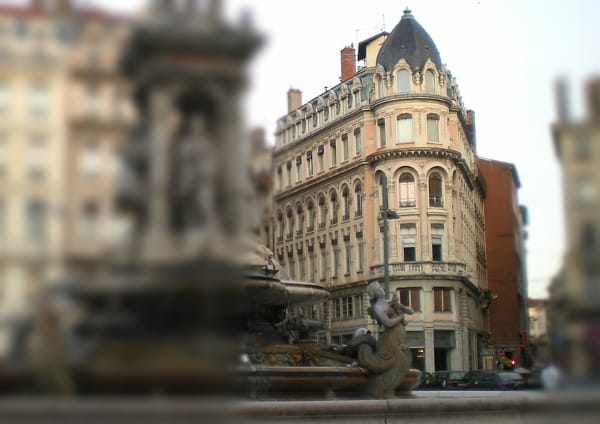
At number 2 rue Childebert to the south-east of the square stands a remarkable building, theRoyal Hotel. Designed by the architect Jules Chatron In 1888, this building was distinguished by its corner rotunda and its elegant dome, which gave it a unique appearance.
The building with Byzantine influences by Pierre Bossan known as Maison Borel

At 4 Place des Jacobins, another building attracts the attention of connoisseurs. Commissioned by the painter Paul Borel, it was designed by the famous architect Pierre Bossan, to whom we also owe the Basilica of Fourvière. His style is a bold blend of influences, notably Romano-Byzantine, which are manifested in its abundant patterns and ornaments inspired by the Orient, a signature of the architect.