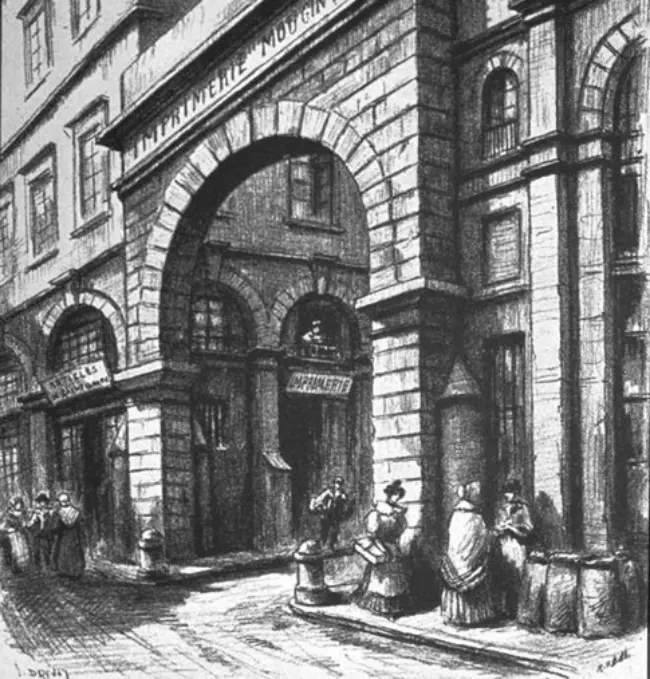
The term "terreaux" refers to the old ditches and medieval mud ramparts ("terre") that protected the city until the end of the 16th century. These elements were filled in to create a vast square where the city's guillotine was erected. It is second in importance, just after Place Bellecour, framed by the Palais Saint-Pierre and the Hôtel de Ville. In 1892, the city council acquired a statue by the famous sculptor Bartholdi (known for the Statue of Liberty) that the city of Bordeaux had commissioned, then subsequently refused.
Conflict
In the 13th century, a major conflict opposed the ecclesiastical powers and the bourgeois of Lyon concerning taxes on goods. It was then that the latter had a revolutionary, somewhat audacious idea: to build a wall.
Protection against Dombes
Their aim was not only to gain commercial independence, but also to own their own homes. Renaud de Forez II, their main opponent, protested and resisted in 1208, before being encouraged by Pope Innocent III to ease tensions, seeing this as progress.
Fortification of the Place des Terreaux

The Place des Terreaux was once a chasm called Terralia Nova. Renaud de Forez II, who had opposed the construction of the wall, took up the idea and began construction. His new objective was to protect the city from a possible attack from Dombes (land of the Germanic Empire).
This wall was colossal, some 500 metres long, 10 metres high and 2 metres thick. Stretching from the foot of the Saint-Sébastien hill, it had 10 towers, drawbridges and a huge moat that could be filled with water in an emergency. The main tower was located on the Saône River to control the Pont de l'Échange – the only crossing between St Nizier and St Jean.
In Latin it was called Terralia Nova ("new ditch of earth and water") or Lantern Ditch, and that is what the Square represented – a huge mud-filled ditch used by crossbowmen as a training ground, but also as a trap for unwanted invaders from the north.
From the town hall to the City Hall

The town hall of Lyon was built in the 17th century. In the 16th century, the wall was in ruins and was demolished in 1538. The moat was filled and the stones from the wall were used by nuns to renovate the convent of Saint-Pierre, which has housed the Museum of Fine Arts since 1803.
Between 1646 and 1651, Simon Maupin built the Hôtel de Ville of Lyon, later rebuilt after a violent fire in 1674 by a certain Jules Hardouin-Mansart. Access to the square was then improved in the 19th century.
The Dark Events

However, the Place des Terreaux was not simply a place of peace and spirituality. Several people were beheaded on this square, including Henri Coiffier de Ruzé, Marquis of Cinq-Mars, conspirator against Richelieu.
During the French Revolution, the guillotine was installed and operated at full capacity under the leadership of Marie Joseph Chalier. And after the siege of Lyon, no fewer than 79 people were beheaded on this historic square.