
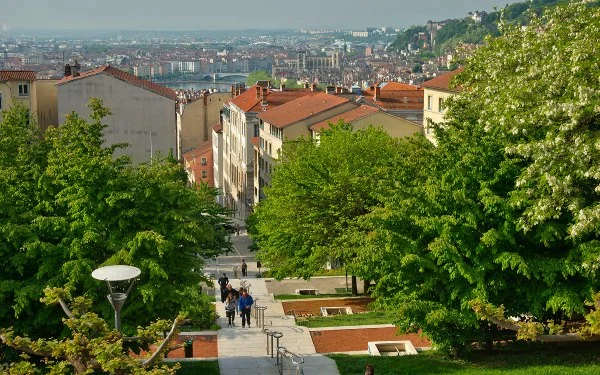
Mnt of the Grande-Côte, 69001 Lyon
Perched on the slopes of Croix-Rousse, the Jardins de la Grande-Côte are a green haven of peace from which a striking view of the city of Lyon unfolds.
History and situation
These terraced gardens extend along the Grande-Côte hill, a historic road that once connected the peninsula to the Croix-Rousse plateau. In the Middle Ages, this area was covered with vines belonging to the canons of Saint-Paul. Today, these gardens are a veritable green lung in the heart of the 1st arrondissement of Lyon.
Exceptional panoramic view
From the top of the gardens, you will discover a breathtaking panorama of Lyon. Before you, the entire grandeur of the city unfolds:
- To the west, the majestic basilica of Fourvière, "the hill that prays", dominates the horizon with its white towers.
- Below, you can take in the whole of Old Lyon, its orange tiled roofs and its mysterious traboules.
- The Place des Terreaux and the Hôtel de Ville are revealed in all their splendor
- On a clear day you can see the Alps to the east, their snow-capped peaks silhouetted against the horizon.
- To the south, the view extends to the confluence of the Rhône and the Saône.
The view is particularly spectacular:
- At sunset, when the golden light illuminates the city's facades
- At night, when the city lights up and the Fourvière Basilica shines brightly
- In spring, when the flowering trees in the gardens frame the panorama
- On days of light fog, when the towers of the basilica emerge like a castle in the clouds
Garden terraces
As you climb the steps, you will discover a succession of terraces that perfectly follow the natural slope of the hill. Each level offers a different perspective on the city:
- The first terrace hosts a Mediterranean garden with its aromatic plants: thyme, rosemary, lavender.
- Further up, you will find a conservatory orchard preserving old varieties of fruit trees.
- At the summit, a belvedere offers you a breathtaking view of the Fourvière Basilica and Old Lyon.
Urban biodiversity
These gardens are a true refuge for urban biodiversity. We observe:
- A wide variety of birds (tits, robins, blackbirds)
- Pollinating insects attracted by the many flowers
- A diverse flora adapted to the local microclimate
The social and cultural aspect
The Grande-Côte Gardens are not just a green space. They represent:
- A meeting place for local residents
- An educational space where gardening workshops are organized
- A cultural site regularly hosting open-air exhibitions and artistic events
Special points of interest
Don't miss:
- The golden stone walls typical of the Lyon region
- The remains of the old traboules that crossed the gardens
- Contemporary sculptures that punctuate the route
- Explanatory panels on the history of the canuts, these silk workers who marked the history of the district
Practical aspects
The gardens are accessible free of charge every day:
- From April 1st to September 30th: 6:30 a.m. – 10:00 p.m.
- From October 1st to March 31st: 6:30 a.m. – 8:30 p.m.
The main access is via the montée de la Grande-Côte, but you can also access it via the rue des Tables-Claudiennes.
Conclusion
These gardens bear witness to the rich history of Croix-Rousse while offering the people of Lyon a space of nature and relaxation in the heart of the city. They perfectly embody the art of living in Lyon, between historical heritage and modernity, between nature and culture.
Our self-guided tours of Brotteaux

The bust of Claude-Marius Vaïsse, described as the Haussmann of Lyon
•
March 4, 2024
The Palais de Flore, built by the architect Clément Laval in 1930, stands out for its imposing stature, reaching a height of 40 metres.

The Palais de Flore, the tallest building in France at the time
•
March 4, 2024
The Palais de Flore, built by the architect Clément Laval in 1930, stands out for its imposing stature, reaching a height of 40 metres.

Brotteaux Station, a place full of history and transformations
•
March 3, 2024
Welcome to the Gare des Brotteaux.
Please note that there was once a small wooden and plaster station, built in 1858 to accommodate the Lyon-Geneva line.

Guimet Museum: abandonment or rebirth?
•
February 19, 2024
Welcome to the former Guimet Museum, a place rich in history and artistic diversity.

The little Valla house in the middle of a building
•
February 18, 2024
You are in front of an astonishing scene where past and present meet. Observe the 19th century villa enclosed in an office building.

Brotteaux Crypt – Victims of the Revolution
•
February 17, 2024
Welcome to the Sainte-Croix Chapel, also known as the Missionaries of Our Lady Chapel.

The smallest house at 28 avenue Maréchal Foch
•
February 16, 2024
Stop in front of number 28 avenue maréchal Foch, where you will find a real curiosity: the smallest house in the city.


